Your feet ache. Your legs ache. By mid-afternoon, those hard floors have done their worst, and the shoes you put on this morning are the reason everything hurts. If you have bunions, the pressure over that bony joint after hours upright can be genuinely miserable.
The shoe that gets you through a full day on your feet does a handful of things well: it has cushioning under your feet that doesn't go flat by lunchtime, it supports your arch instead of leaving it to collapse under your own weight, and it gives your toes room to sit naturally rather than cramming them into a narrow toe box. If you have a bunion, width in the toe box, not a bigger shoe all round, is what takes the pressure off the joint.
Calla makes shoes for women with bunions and wide feet. Every pair is designed in the UK and handmade in Portugal, with a wide toe box over a standard-width heel, so your foot doesn't slip at the back while your bunion gets the room it needs at the front. The picks below are the ones we'd point you to first for long days on your feet, from a chunky-soled sneaker built for the hardest floors to a smart leather pump that passes any dress code.
Please remember that the advice below is general, and if you are experiencing foot pain you need to see your podiatrist.
Here are the shoes we recommend for standing all day:
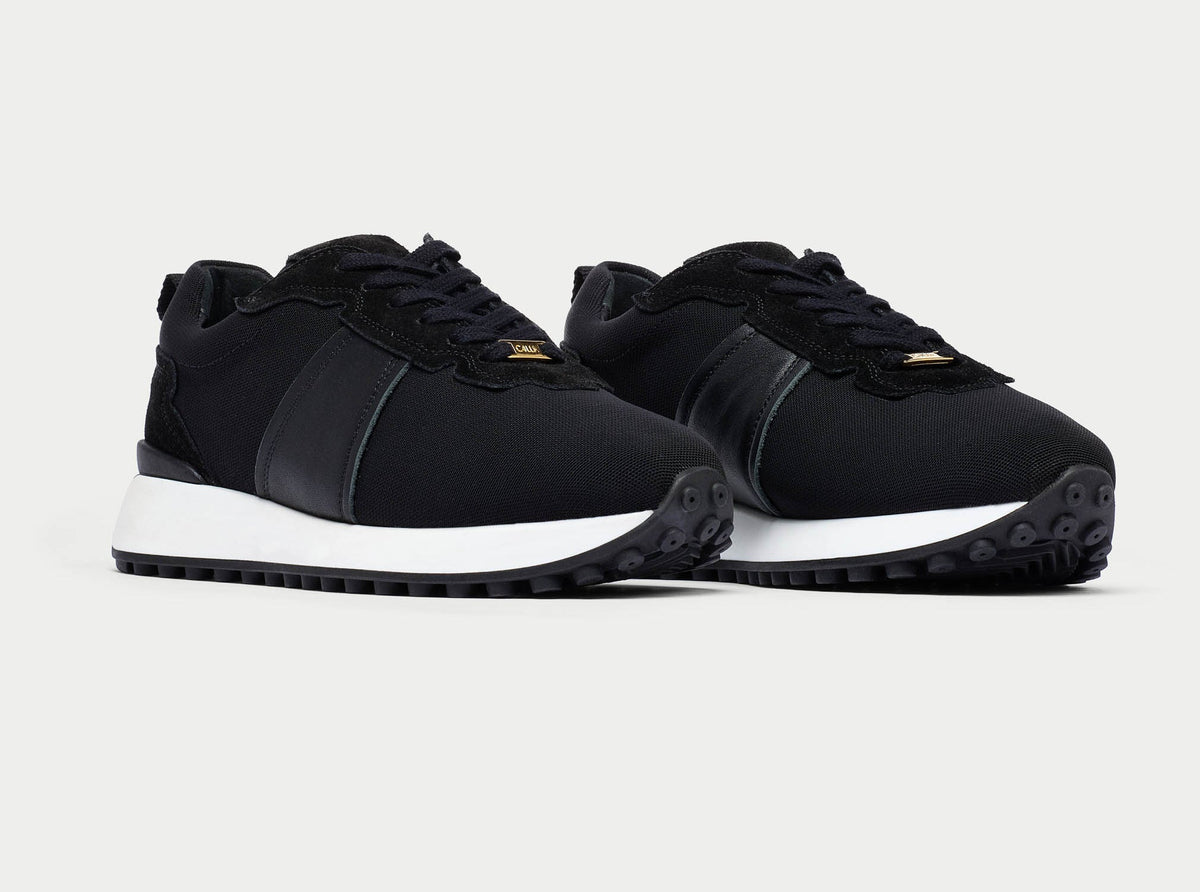
The Cosmos is the chunky trainer Calla's founder built because the dad-trainer trend kept squeezing her bunions, and black is the wear-with-everything one. A chunky cushioned outsole adds height, while the wider, deeper toe box and removable insole give the forefoot room and take your orthotics. Fits EE-EEE, true to size.
Origin
Handcrafted in Portugal at a family-run factory in the Porto region
Material
Black leather upper with textile side detail, lamb leather lining
Heel
Flat with chunky outsole
Closure
Lace-up
Fit
Wide fit, EE and EEE width feet, standard fit around the heel with additional width and depth in the toe box
Insole
Removable moulded footbed with arch support, swap for own orthotics
Browse more images of the Cosmos - Chunky-Sole Black Wide Fit Sneakers:
Our Review
Black is the Cosmos I reach for most, because a chunky trainer usually crushes my forefoot and this one was designed by someone with bunions to do the opposite. The wider, deeper toe box means my bunion has room inside a sporty shape, and the insole lifts out for my orthotics. The chunky outsole gives me a bit of height and a lot of cushioning on hard pavements without any forefoot pressure. In black it goes with jeans, joggers or a midi without a thought. True to size in a wide fit, EE-EEE.
Pros
Chunky outsole gives lift and stride length without putting pitch through the forefoot
Removable footbed accepts the wearer's own orthotics
EEE width cap with extra toe-box depth accommodates wider forefeet and Morton's neuroma
Lace-up closure adjusts across the instep
Cons
Chunky-sole silhouette is heavier on the foot than a standard trainer profile
Leather upper needs conditioning to keep the side panels looking fresh
Sporty trainer styling means it will not slot into smart workwear or occasion outfits
The Star trainer in black quilted leather, the quilting adding a padded diamond texture to a plain black sneaker. A fully lined seam-free toe box gives the bunion a smooth surface, while lace-ups open the forefoot to an EEE. Fits EE-EEE, true to size.
Origin
Handcrafted in Portugal at a family-run factory in the Porto region
Material
Quilted black leather upper, lamb leather lining
Heel
Flat
Colour
Black
Fit
Wide fit, fits EE-EEE width feet
Toe box
Wider toe box with extra depth, fully lined with no internal seams, standard fit around the heel
Browse more images of the Star - Black Quilted Leather Wide Fit Sneakers:
Our Review
I reach for the quilted black Star when plain black feels a bit flat, because the padded diamond stitching gives the shoe some surface interest while still going with everything. The toe box is fully lined with no inner seams, so there's nothing catching on my bunion through a day of walking, and the laces let me loosen the forefoot when my foot widens later on. It keeps the standard Calla heel, so it stays secure at the back while giving my toes room at the front. I wear it with jeans or black trousers without thinking about it. True to size, EE-EEE.
Pros
Quilted leather surface adds visual texture to the standard black trainer
Removable moulded footbed accepts your own orthotic
Seam-free interior toe box reduces rubbing on the bunion joint
EE-EEE width range with laces to fine-tune the forefoot
Cons
Fit stops at EEE so EEEE width feet will not fit
Quilted stitching adds surface points that can catch on bags or trouser hems
The Estella is Calla's zip-up trainer with no laces to tie, and black leather is the smart everyday one. A side zip means easy on and off without bending, while the removable moulded footbed and wider fit give the bunion room and take your orthotics. Fits up to EEE, true to size.
Origin
Handcrafted in Portugal, designed in the UK
Material
Black leather upper, lamb leather lining
Heel
Flat
Width cap
Fits up to EEE width feet
Toe box
Wide toe box
Closure
Side zip instead of laces
Footbed
Removable moulded footbed, swap in your own orthotics
Press
Voted one of the best stylish trainers for wide feet by Hello, Good Housekeeping, The Independent, The London Evening Standard
Browse more images of the Estella - Black Leather Zip-Up Wide Fit Sneakers:
Our Review
The black Estella is the trainer I reach for when I don't want to bend down and tie laces, because the side zip means I step straight in and out. In black leather it looks tidy enough for a casual office or smart-casual day, not just the gym. The wider fit and moulded footbed give my bunion room, and the footbed lifts out for my orthotics. The zip also means a consistent fit every time rather than laces I retie. True to size, up to EEE.
Pros
Side zip means you slip the trainer on without retying laces
Removable moulded footbed for own orthotics
EEE width fitting accommodates wider feet than most trainer brands
Black leather hides scuffs and city-pavement marks better than white
Cons
Zip is a moving part that adds a wear point lace-ups do not have
No laces means no further width adjustment beyond the fixed zip line
All-black trainer reads more formal than casual so it suits office and smart-casual wear more than sport
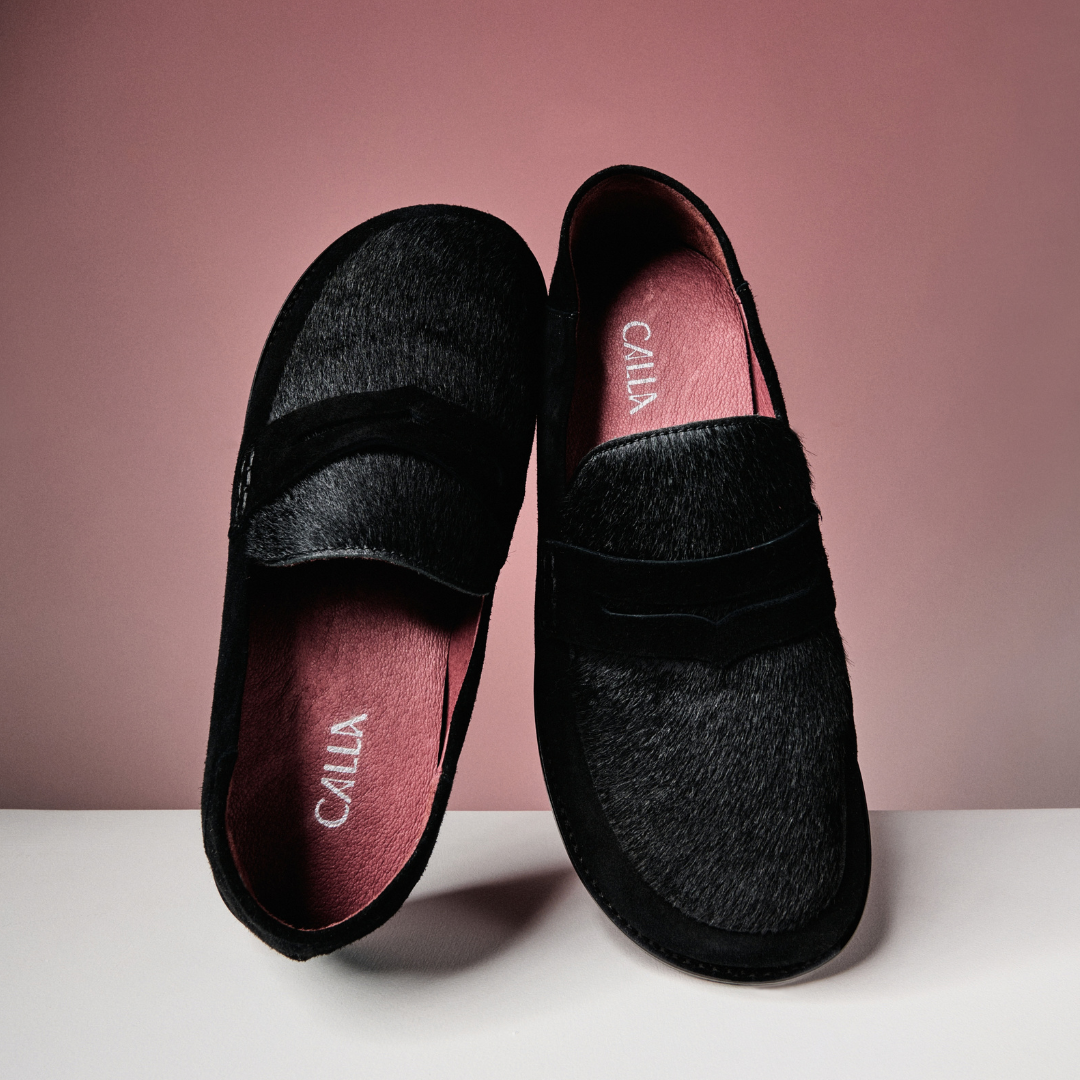
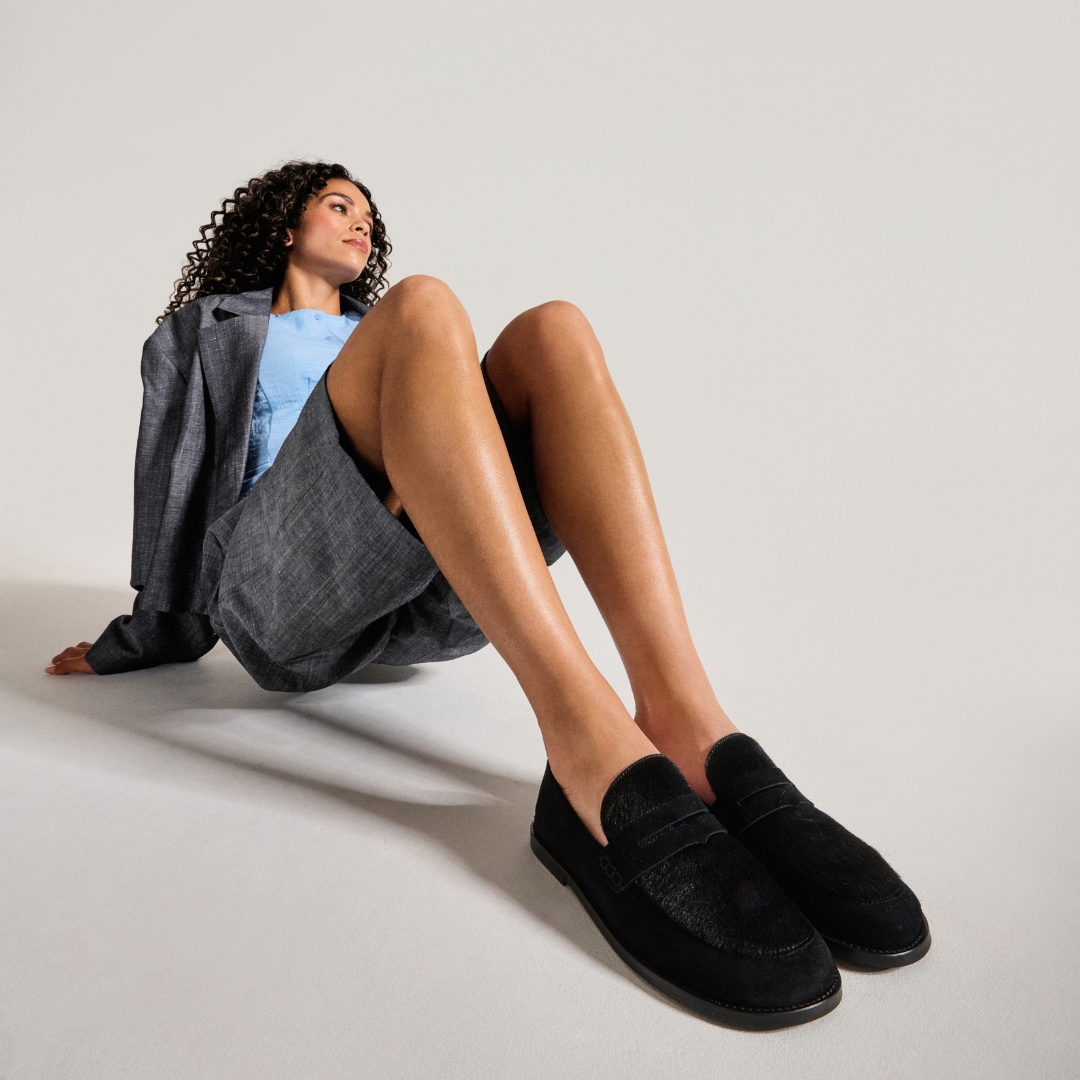
The Meredith is Calla's chunky loafer on a 2.5cm heel, and black leather is the do-everything one. The slight heel and cushioned sole carry a day from the office to dinner, while the wide-enough toe box gives the bunion room a slim loafer wouldn't. Fits up to EE, true to size.
Origin
Handcrafted in Portugal, designed in the UK
Material
Black chunky leather upper, lamb leather lining
Heel
2.5cm
Width cap
Fits up to EE width feet
Toe box
Wide toe box with hidden stretch panel over the bunion area
Browse more images of the Meredith - Black Leather Loafers:
Our Review
The black Meredith is the chunky loafer I wear when a flat feels too slight for tailoring, since the 2.5cm heel and the heavier sole give it some presence under trousers. It takes me from the office to dinner without changing, and the cushioned sole means my feet aren't aching by the evening. The toe box is cut wide enough that my bunion has room rather than being pressed by a narrow loafer. I wear it with trousers or straight jeans. Fits up to EE, true to size.
Pros
2.5cm heel adds height without losing the loafer's flat-shoe ease
Hidden stretch panel flexes over the bunion joint
Cushioned sole takes the impact out of pavement walking
Fits up to EE width feet
Cons
Width fitting caps at EE so EEE feet will be tight
Chunky silhouette sits heavier on the foot than a slim loafer
Slip-on construction means no width adjustment if your foot swells through the day
The Charlotte is Calla's crossover ballet flat, the one customers keep coming back to, here in soft black nappa leather. The leather crosses over the toes and stretches across the bunion, with a panel that gives both bunions and tailor's bunions room. Fits up to EEE, true to size.
Origin
Handcrafted in Portugal at a family-run factory in the Porto region
Material
Soft black nappa leather upper, lamb leather lining
Heel
Flat ballerina
Colour
Black
Fit
True to size, fits up to EEE width feet
Toe box
Stretch panel across the toe box for bunions and tailor's bunions, crossover design that stretches to the foot shape
Footbed
Enhanced arch support, extra cushioning at the heel
Browse more images of the Charlotte - Black Leather Ballerinas:
Our Review
Black Charlotte is the ballet flat I reach for most, because the crossover design stretches gently over my bunion instead of pressing a hard line across the joint. The soft nappa leather gives where my foot is widest, and the stretch panel handles both my bunion and the tailor's bunion on the little-toe side. Enhanced arch support and extra heel cushioning mean it carries a full day rather than leaving my feet flat and sore. It is the flat I'd recommend to anyone after a bunionectomy who needs softness and width over the scar area. Fits up to EEE, true to size.
Pros
Stretch panel across the toe box gives over both the bunion and the tailor's bunion sides
Nappa leather softens with wear
Extra heel cushioning eases the back of the foot
Fits up to EEE width
Cons
Flat ballerina sole has limited grip in wet weather
Crossover stretch design relies on the panel rather than laces so cannot be tightened
A classic black leather court on a manageable 5cm kitten heel, with extra width and volume through the toe area for a wide forefoot. The roomy toe and arch support carry a full office day, where a standard court would press on the bunion by mid-morning. Fits EE-EEE, true to size.
Origin
Handcrafted in Portugal at a family-run factory in the Porto region
Material
Black leather upper, lamb leather lining
Heel
5cm kitten heel
Fit
Fits EE-EEE width feet best
Toe box
Extra width and volume in the toe area, standard at the heel
Footbed
Arch-supported insole
Best for
Work, weekday dressing and any wardrobe slot that wants a low heel
Browse more images of the Ava - Black Leather Pumps:
Our Review
The black Ava is my everyday work court, the pair I put on for a day of meetings because a 5cm heel is low enough to stand and walk in from morning to evening. What makes it work for me is the extra room through the toe area, an EE-EEE that lets my bunion sit without the joint pressing on a hard leather edge the way a standard court does. The arch support holds my foot through hours on office floors. In smooth black leather it goes under any suit or with a pencil skirt. True to size for me across the EE-EEE width.
Pros
5cm kitten heel works for full work-day standing
EE-EEE width cap takes wider feet than most courts on the high street
Extra width and volume in the toe area accommodates the bunion joint
Lamb leather lining over the bunion area flexes with the joint
Cons
Smooth leather sole needs grip pads on wet pavement
Narrower than EE feet may find the toe area roomy
Black leather shows light scuffs at the toe over time
The Saturn platform trainer in clean white leather, the wearable everyday version of the platform on a 3cm sole. The platform adds even height with no heel pitch, while the wider seam-free toe box gives the bunion a smooth surface. Fits EE, true to size.
Browse more images of the Saturn - White Leather Wide Fit Sneakers:
Our Review
White leather is the Saturn I reach for when I want the platform height in something that goes with everything, since white leather keeps it clean and easy where the suedes are bolder. The 3cm platform lifts me evenly without pushing my weight forward onto the bunion. The seam-free toe box stops the joint rubbing, and the laces let me adjust the forefoot. It fits an EE rather than EEE, so it suits a moderately wide foot. True to size, and white leather wipes clean easily.
Pros
Seamless lined toe box removes the stitching that usually rubs over the bunion joint
3cm platform adds height without changing the flat foot position
Laces let you loosen the forefoot independently of the heel
Fits up to EE width
Cons
White leather shows scuffs and dirt fastest of any colour
Width fitting tops out at EE so EEE feet will be tight
Lace-up means more setup than a slip-on for everyday wear
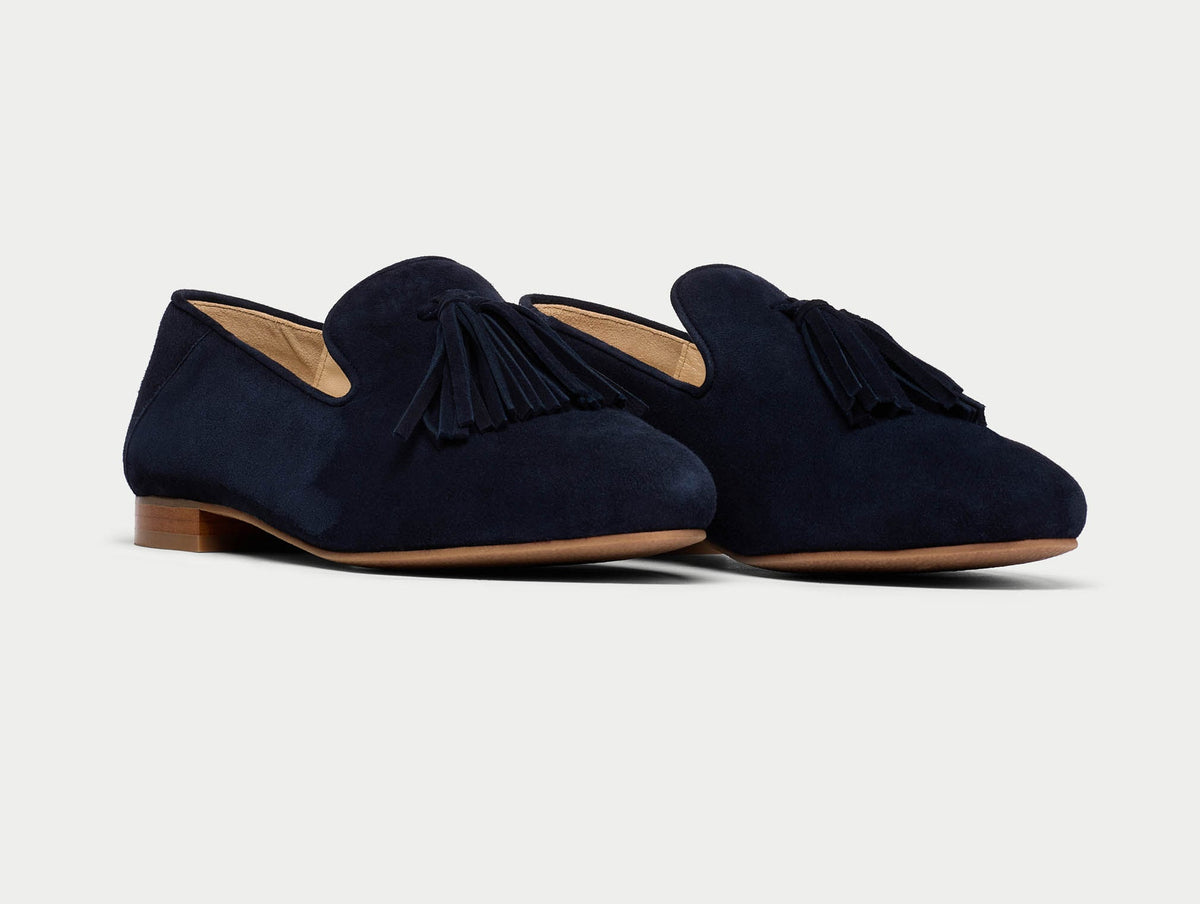
The Freya is Calla's tassel loafer, and deep navy suede is the dark, velvety version for work and evenings out. A hidden stretch panel in the toe box gives over the bunion, the lining is one piece with no seams to rub, and it sits on a 1cm heel with an arch-supported insole. In suede it runs a little big, so order a full size down, and it fits up to EEE.
Origin
Handcrafted in Portugal at a family-run factory in the Porto region
Material
Deep navy suede upper, leather lining
Heel
1cm
Fit
Runs a little big in suede, size down a full size
Width
Up to EEE in the toe box, standard (D) heel
Toe box
Hidden stretch panel over the bunion area, one-piece lining with no inside seams
Browse more images of the Freya - Deep Navy Suede Loafers:
Our Review
A lot of loafers are off-limits when you have a bunion, because the seam on the inside digs straight into the joint, so the Freya is lined in one piece and has a really big hidden stretch panel right where my bunion sits. Deep navy is the one I'd choose for work, because it looks softer than black next to navy or grey tailoring, and the suede has a velvety nap that suits the tassel. The 1cm heel and arch-supported insole keep my feet supported from the office through to dinner. The suede is very soft, so put a protector on before you wear them, and it runs a little big, so go down a full size. It fits up to EEE across the bunion, so a large bunion is fine as long as the rest of your foot is narrow or standard.
Pros
Hidden stretch panel in the toe box gives over the bunion joint
One-piece lining has no inside seams to rub the bunion
Half sizes from EU 36 to 42
Dark navy suede sits well with navy, grey and black tailoring
Cons
Suede runs a little big, so you need to size down a full size
Soft suede marks in the rain unless you treat it with a protector first
Large bunions need a narrow to standard width through the rest of the foot
The Luna vegan trainer in white recycled canvas, the fresh version of Calla's first vegan shoe, responsibly sourced in Portugal and Italy. A removable moulded footbed takes your orthotics and a seam-free lining gives the bunion a smooth surface. Fits EE-EEE, true to size.
Origin
Materials sourced in Portugal and Italy, handcrafted in Portugal
Material
Recycled canvas upper, vegan
Heel
Flat
Fit
Fits EE and EEE width feet, standard fit around the heel with additional width and depth in the toe box
Browse more images of the Luna Vegan - White Wide Fit Sneakers:
Our Review
White Luna is the vegan trainer I wear in summer, since the recycled canvas is light and the white keeps it fresh with a summer outfit. The footbed lifts out for my orthotics, and the seam-free lining means nothing rubs my bunion on a long day. The wider, deeper toe box gives my forefoot room. It is good to have a vegan option that is as supportive as the leather trainers. Fits EE-EEE, true to size, and I keep the white canvas away from mud.
Pros
Removable footbed lets the wearer swap in their own orthotics
Seamless lining reduces rubbing on sensitive feet and bunion areas
EEE width cap with extra depth accommodates wide and deep forefeet
Vegan recycled canvas upper for buyers avoiding leather
Cons
White canvas marks visibly and benefits from a fabric protector spray
Flat pitch will not suit anyone needing heel height for arch comfort
Casual trainer styling means it will not slot into formal occasion outfits
The Ophelia is Calla's classic brogue in a mix of smooth black leather and soft suede, with the brogue detailing across the toe. A hidden stretch panel in the toe box gives the bunion room and flexibility, on an EEE toe width. Fits up to EEE, true to size.
Origin
Handcrafted in Portugal at a family-run factory in the Porto region, designed in the UK
Material
Smooth black leather and soft suede upper, lamb leather lining
Heel
Flat
Fit
True to size
Width cap
Fits up to EEE toe width
Toe box
Wide Calla last with hidden stretch panel in the toe box
Browse more images of the Ophelia - Black Leather Brogues:
Our Review
Black Ophelia is the brogue I reach for when I want a smart flat that goes with everything, since the leather-and-suede mix and the brogue detailing look polished with trousers or jeans. The hidden stretch panel in the toe box gives over my bunion so the brogue doesn't press the joint. The shape leaves extra room and flexibility through the forefoot. It is the flat I wear most through autumn and winter. Fits up to EEE, true to size.
Pros
Hidden stretch panel in the toe box flexes over the bunion joint
EEE width cap accommodates wider forefeet
Mixed leather and suede upper takes both office and weekend outfits
Flat heel suits all-day standing and walking
Cons
Suede panels need weatherproofing before wet-weather wear
Black suede shows salt marks in winter
Lace-up entry takes longer to put on than a slip-on flat
What makes a shoe comfortable enough to stand in all day
If you have bunions and wide feet, you need lasting cushioning that does not bottom out, genuine arch support, room over the bunion in the toe box, and a stable base underneath. They're what separate a shoe that survives ten hours from one that feels fine in the shop and falls apart by mid-shift.
Cushioning that lasts
Cushioning matters most on hard floors. Concrete, tile and laminate don't give back any energy, so the sole has to absorb the impact of every step and every minute you spend standing still. But a soft sole is not always a supportive one. A thick, pillowy sole that feels wonderful at nine in the morning can compress and flatten by the afternoon, leaving you standing on what amounts to a thin board. A firmer, higher-density foam keeps its shape all day.
Arch support
Arch support spreads the load across the whole of your foot, taking some of it off the heel and the ball of your foot. Without it, your arch drops, your foot rolls inward, and the strain travels up through your knees and into your lower back. If you have bunions, that inward roll (called overpronation) is often part of what contributed to them in the first place, so supporting the arch does the basic structural job your foot needs.
Room in the toe box
Room in the toe box is what makes the difference for a bunion. Your toes need space to sit naturally, and a bunion needs room to exist without being pressed against a stitching line or a seam. The fix is width across the forefoot, not a bigger shoe all round.
A stable base underfoot
A completely flat sole is not the best choice for a long day on your feet. A modest, stable heel, even a low block or a slight lift built into the insole, eases the strain on your calves and on the band of tissue under your arch. It won't take pressure off the ball of your foot, though: the higher the heel, the more of your weight goes onto the front of your foot and the big-toe joint. It doesn't need to be high. Even a centimeter or two makes a difference over a long day.
Breathable uppers
Breathable uppers help too, particularly if you work indoors where the heating never turns off. Leather breathes better than synthetic fabric and molds to your foot over time, so the shoe takes on your shape.
The Calla Comfort Method
We build all of this into our shoes through what we call the Calla Comfort Method: extra width and depth in the toe box over a standard-width heel, with a cushioned, arch-supported insole and, on many styles, a seam-free stretch lining that covers the bunion area without rubbing. In our sneakers, the insoles are removable and molded to support the arch, so you can use your own orthotics if your podiatrist has prescribed them. Every pair is handmade in Portugal by master shoemakers, and the leathers and linings are chosen for softness and flexibility, so they ease with wear. Our leather comes from suppliers certified by the Leather Working Group, and the factory was independently audited in 2026 to the Sedex SMETA standard for labor practices and health and safety.
Our pick of shoes for long days on your feet
We've chosen six styles from our range that cover the ground from a chunky-soled sneaker with the most underfoot cushioning we make, through to a smart leather pump for days when you need to dress smart.
If you're on hard floors for long hours, we recommend the Calla Cosmos or Calla Star sneakers for the deepest cushioning and a removable footbed that takes your own orthotics. If you need something smarter, the Calla Meredith loafer gives your bunion room and your arch support in a silhouette smart enough for any office. If bending to tie laces is difficult after a long shift, the Calla Estella sneaker has a side zip so you can get in and out without undoing your laces.
Long shifts at work: nursing, teaching, retail and hospitality
Nurses, carers, teachers, retail staff and hospitality workers spend more continuous hours on hard floors than almost anyone else, and the right shoe for a long shift comes down to what your feet need and what your uniform allows.
Nursing, care and wards
If you're on a ward or in a care home, you're likely standing and walking for ten to twelve hours on polished floors, often in a warm building. You need cushioning that lasts the full shift, arch support that doesn't fade, and room over your bunion so the pressure from hours of standing doesn't build against the joint. A shoe you can get on and off quickly helps too: laces you set once and forget, or a side zip, both work well when bending to tie shoes is the last thing you want at the end of a double. The Calla Estella sneaker gives you both in one shoe: laces that set the fit to your width, and a side zip for getting in and out without having to retie.
Before you buy, check your hospital's or employer's uniform policy. Many hospitals ask for closed-toe, wipe-clean shoes with slip-resistant soles, some don't allow sneakers on the wards, and operating rooms and some departments have their own rules. Where your policy asks for certified slip-resistant or safety footwear, that comes first.
Teaching and retail
Teaching and retail involve different pressures. The floors are just as hard, but the dress code is often smarter, so a plain black leather sneaker or a leather loafer in a dark color tends to pass where a sporty-looking shoe wouldn't. If you're in a school, you're on your feet and moving between classrooms all day, so a supportive, cushioned flat with a secure heel hold is a better choice than something that looks the part but leaves your arch aching by break time.
Hospitality
In hospitality, there's also the question of spills. Leather wipes clean easily, which is a practical advantage over fabric or mesh uppers in a kitchen or a bar. If your workplace requires certified slip-resistant footwear or steel-toe safety shoes, though, that's a separate category entirely. No fashion or comfort shoe, ours included, replaces certified safety footwear where the rules require it.
Sneakers, flats and low heels for standing all day
A sneaker gives you the most cushioning. A flat or a loafer keeps things smarter. A low block heel gives you a little height for smarter days, as long as it stays low and broad. All three can work for a full day on your feet if the toe box gives your bunion room and the insole supports your arch, so the right one depends on your day.
How a shoe looks matters too, because a supportive shoe you won't wear doesn't help. Dina Gohil, a podiatrist registered with the Health and Care Professions Council (HCPC), reviewed the Calla range and called it refreshing that for shoes designed for bunions and wide feet, 'they don't look hideous,' noting that her patients routinely refuse recommended footwear on appearance grounds.
Sneakers for all-day cushioning
Sneakers for standing all day with a bunion need a cushioned, arch-supported insole, a seam-free toe box, and the stitching line kept off the bunion so nothing presses or rubs against the joint over hours. A removable footbed (the shaped insole inside the shoe) deep enough to take your own orthotics is worth looking for, because it means the shoe works with whatever support your podiatrist has prescribed.
What most wide-width sneakers get wrong is where the width is placed. There are lots of wide width shoe brands out there, but a lot of the time those shoes are wide all over, so your foot slips at the heel and you end up with blisters. Calla sneakers are built on a last that's wider across the forefoot, up to an WW width, and standard at the heel, so your foot stays secure at the back while your bunion gets room at the front. The uppers are soft leather or suede that ease with wear, and the toe box is fully lined with no internal seams, so there's nothing to catch or rub against your skin. On the outside, we move the stitching line forward so it runs ahead of the bunion joint rather than across it, so no overlay crosses the bony prominence and the shoe conceals the bunion behind a clean panel of leather.
A flat only works for standing all day if it has genuine arch support built in. A thin-soled ballet flat with no structure underneath looks elegant, but after a few hours on your feet you feel the lack of support: your arch drops, the ball of your foot takes more load, and if you have a bunion the pressure over the joint builds without anything to spread it.
A flat that works for a full day has a cushioned, arch-supported insole, a slight heel lift or at least a shaped footbed, and a lining that doesn't rub. Loafers, supported ballerinas and brogues all keep things smart-casual while still giving your foot the structure it needs. Look for a wide toe box with a stretch panel or soft lining over the bunion area, and a sole firm enough to last the day without collapsing.
A low, stable block heel can work for standing if the heel height stays modest and the base is wide enough to keep you steady. The higher the difference between the heel and the front of the shoe, the more pressure you're putting on your toe joints, and if you have a bunion, your big-toe joint is already taking extra pressure, so keep the height modest.
Standing still for long periods is a different problem from wearing heels for a few hours. If you're looking for a comfortable heel for an occasion, a dinner or a wedding or an evening out, we've covered it properly in our guide to the most comfortable heels for bunions.
If your feet swell or ache by the end of the day
Swelling in the afternoon, a sore big-toe joint after hours upright, or burning and numbness under the ball of your foot each have a different cause. Roomy, supportive shoes ease the pressure and change how your foot feels through a long day, but they don't cure or reverse a structural condition. If the pain is persistent or getting worse, that's a conversation for your podiatrist, not something to solve with a shoe alone.
Feet that swell through a long day
Feet that swell a little over a standing day are common, and mild swelling in both feet isn't usually a sign that something is wrong. Blood pools in your lower legs when you're upright for hours, your feet expand, and shoes that fitted perfectly at eight in the morning feel tight by three in the afternoon. The fix is to fit for your feet as they are in the afternoon.
Swelling isn't always down to standing, though. The UK's NHS guidance on swelling advises getting urgent help the same day (in the US, from your doctor or an urgent care clinic) if the swelling is in one foot or leg and you don't know why, if the area is red or hot to the touch, or if it's severe, painful or starts very suddenly, and calling 911 if you're short of breath or your chest feels tight or painful. If both feet are swollen and it hasn't improved after a few days of looking after it at home, see your doctor.
Laces help, because you can loosen them as the day goes on. A stretch panel across the toe box adjusts for swelling too, and it accommodates two feet that aren't quite the same width, which is more common than you'd think. Buying shoes in the evening, when your feet are already at their largest, is the simplest way to avoid the pair that pinches by lunchtime.
If you have a bunion and your big-toe joint aches after hours on your feet, the pain comes from pressure over the bony prominence and from the joint itself being loaded by your body weight hour after hour. A shoe that eases that needs room over the bunion so nothing presses against it, a stitching line kept off the joint, and a seam-free lining inside the toe box so there's no ridge to catch against your skin.
Calla shoes are shaped with extra width and volume in the toe box to accommodate bunions, many with a discreet stretch panel that flexes where you need it most, and soft linings that reduce rubbing. In our sneakers, the removable insole means you can use your own orthotics if your podiatrist has prescribed them.
Footwear does affect how a bunion behaves over time. Shoes that crowd your toes don't cause a bunion on their own, but the American College of Foot and Ankle Surgeons notes they can make one progressively worse. What no shoe can do is reverse it. A roomy shoe takes the pressure off the joint, so it rubs less and the day is more comfortable, but only surgery changes the bone. Ron McCulloch, the principal Podiatric Surgeon and Director of the London Podiatry Center, puts it plainly:
Once a bunion has formed it is usually not possible to reverse the condition without surgery. The best one can hope for is to slow down progression and to limit the worsening of the deformity by taking some simple measures.
The most important of those measures, he says, is to wear 'good shoes with a round toe and a relatively low heel'.
Our shoes are designed for a foot that's wider at the front than the back. If your foot is wide all over, or you have a very large bunion on a very wide foot, the fit may not be right for you.
A burning sensation or numbness under the ball of your foot after long hours standing usually comes from compression across the forefoot. The nerves between your metatarsal bones (the long bones behind your toes) get squeezed, and the result can feel like standing on a pebble, or a patch of numbness that spreads into your toes. If a specific nerve between the bones is involved, your podiatrist may call it Morton's neuroma (a thickening of the tissue around one of the nerves). Our guide to shoes for Morton's neuroma covers what to look for if that's your diagnosis.
Room across the forefoot and cushioning underneath it help, because they reduce the compression that triggers the sensation. A wide toe box gives the bones room to spread, and a cushioned insole absorbs the load. If the burning or numbness is regular or getting worse, see your podiatrist, because the right diagnosis changes what actually helps.
How to get the size and width right
Measure your feet and try shoes at the end of the day, when your feet are at their largest.
A 2018 review by Buldt and Menz found that between 63 and 72% of people were wearing shoes that did not accommodate either the width or length of their feet, with 50% of women and 34% of men in shoes that were too narrow.
If you have diabetes, numbness or poor circulation in your feet, take extra care with fit, because over a long shift you may not feel a shoe rubbing until it has caused a blister. UK NHS foot-care advice for people with diabetes is to make sure shoes fit well in length, width and depth, to avoid slip-ons, and to check your feet every day for broken skin and blisters. Your podiatrist or diabetes team can check your fit too, and if you've lost feeling in your feet, have that done in person before you wear a new pair for a full shift.
Measuring for width
Width matters at least as much as length, and bunions make it matter more. When you size up in length to get width, you end up with shoes that are too long: your foot slides forward, your toes jam into the front of the shoe, and you're back to square one. What you actually need is width in the toe box with a standard fit at the heel. Width is measured as a letter grade: W is wide, WW is extra wide. Measure the circumference around the widest part of your foot, usually across the bunion, while you're standing, because your foot spreads under your weight.
Calla shoes are designed with varied width options and toe boxes that accommodate up to an WW width across the forefoot while keeping a standard heel. That means you can wear your true size and get the room your feet actually need, without your heel slipping at the back.
If you're between sizes
If you're between sizes, or your feet swell noticeably through the day, going up half a size usually gives you the margin you need. Once the insole in any shoe starts to pack out and flatten, the cushioning and shock absorption go with it. When it stops springing back, it's time for a new pair.
What are the most comfortable shoes for working 12-hour shifts?
For a 12-hour shift, we'd recommend the Calla Cosmos sneaker: it has the chunkiest, most cushioned sole we make, a molded footbed with arch support that lifts out for your own orthotics, and a toe box that fits W and WW feet with a standard fit at the heel. If you need to look smarter, the Calla Meredith loafer gives your bunion room in a shoe smart enough for most workplaces. The most comfortable shoe for a 12-hour shift is a cushioned, arch-supported one with a wide toe box that gives your bunion room and enough volume for your feet to swell through a long shift. A sneaker gives you the most underfoot cushioning for a twelve-hour day. If you cannot wear sneakers, a smart leather flat or low pump with a removable, arch-supported insole is the next best thing. In both cases, fit for your feet as they are in the afternoon.
Are running shoes good for standing all day?
Running shoes are built for forward motion, not for standing still. The rocker geometry and narrow waist that help a runner push off efficiently don't provide the broad, stable platform your foot needs for hours in one spot. Racing shoes are also often cut narrow across the front, which is exactly the wrong thing for a bunion. A stable, cushioned shoe with a flat base and room across the toe box, such as the Calla Cosmos sneaker, is a better choice for standing than any shoe designed for running.
What shoe is best for lots of walking at work?
For lots of walking at work, we recommend the Calla Star sneaker: it has a cushioned, arch-supported footbed that lifts out, laces so you can adjust the width across the front of your foot, and a fully lined toe box with no seams to rub a bunion. A cushioned, supportive sneaker with a removable arch-support insole works well for both standing and walking. The removable insole means you can fit your own orthotics if you have them, and the cushioning absorbs impact whether you're on your feet in one spot or moving through a building all day. For bunion feet, make sure the toe box is wide enough that the shoe doesn't press on the joint and that the lining inside is seam-free, so nothing rubs as you walk.




Leave a comment
This site is protected by hCaptcha and the hCaptcha Privacy Policy and Terms of Service apply.